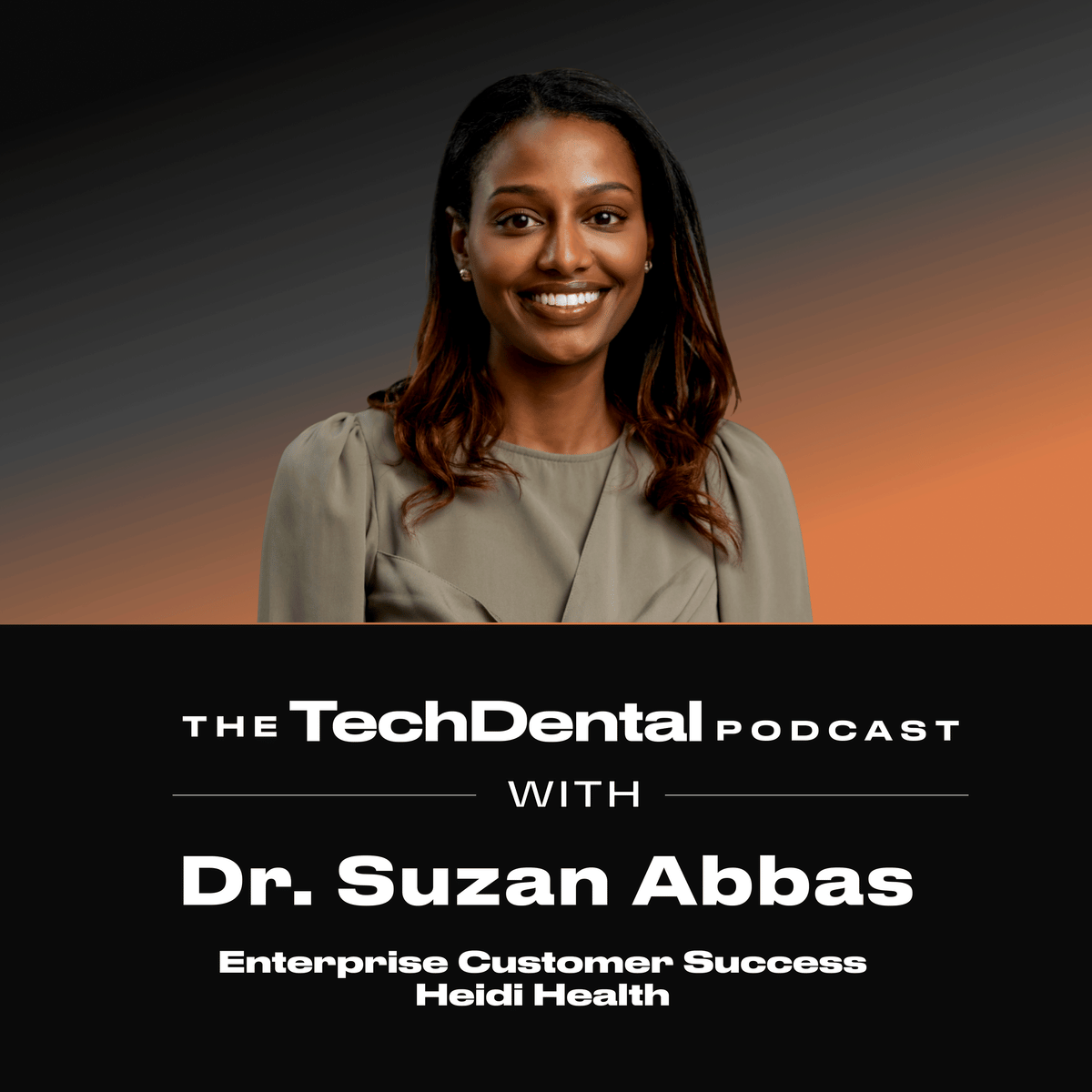
Direct answer: Burnout in dentistry is not primarily a wellbeing problem. It is an operating system failure. The documentation burden that accumulates across a clinical day, finishing notes, writing radiograph reports, drafting referrals, adds up to an hour or more of additional cognitive load that spills into lunch breaks, evenings and clinical headspace. Dr Suzanne Abbas, clinician turned enterprise health tech leader at Heidi Health, argues that ambient AI is not about automating notes. It is about redesigning how clinical thinking is translated into records, safely and without compromising governance. This is the conversation dentistry needs to be having.
Is Burnout in Dentistry a Wellbeing Problem or a Systems Failure?
The profession has spent years treating burnout as a personal resilience issue.
Mindfulness programmes. Wellbeing initiatives. Flexible working guidance.
All of it well-intentioned. None of it addressing the root cause.
Dr Suzanne Abbas has a more precise diagnosis.
"I think primarily it's an operating system failure. If your diary is literally designed with no buffer, constant time pressure, heavy admin, patient overload and no recovery time, then burnout is actually a very valid and normal and fair response. And you can't mindfulness your way out of that situation."
This reframe is important for anyone in a leadership position across dentistry. Burnout is not a signal that clinicians need more resilience training. It is feedback that something in the operating model is structurally wrong.
"I see burnout as feedback. It's feedback that something somewhere isn't quite right. So if you have high levels of burnout in a particular practice or a particular industry or a particular team, then it's a signal that something's not quite right there."
For Abbas, the personal experience of burnout was not born from disengagement. It was the opposite.
"When I was practising, I didn't burn out because I didn't care. It was the opposite. I felt burnt out because I cared too much and the system also demanded too much all the time."
That distinction matters for how practice leaders interpret the signals they are receiving from their clinical teams. The dentists most at risk of burnout are often the most committed ones. The ones who stay late to finish notes not because they are disorganised, but because they care about the quality of their records.
The structural issue is not effort. It is diary design, workflow design and system integration.
We examined the operational architecture that drives burnout in depth in Burnout in Dentistry Is Not a Wellbeing Crisis
Where Does Documentation Most Quietly Erode Clinical Capacity?
The largest hidden tax on clinical capacity in dental practice is not the complexity of individual documentation tasks. It is their relentless repetition, accumulated invisibly across every appointment, every day, every year.
Documentation does not feel catastrophic in the moment. That is precisely what makes it dangerous.
A few minutes finishing notes after each appointment. A radiograph report. A referral letter. Each one individually manageable. Collectively, across a full clinical day, they can easily add up to an extra hour of administrative load.
"Over a full clinical day, that's huge. And by the end of the day, it can quite easily add up to an extra hour of admin. And that time, it spills into lunch, into gaps between patients or into the end of the day when you're already tired."
The cognitive dimension compounds the time dimension.
Documentation requires focus, but not clinical creativity. It consumes cognitive resources without providing the reward that clinical work does. Over time, that low-level cognitive drain erodes morale in a way that is gradual and therefore easy to normalise.
"Documentation does require focus, but not clinical creativity. So you're using your brain, but just not in a very rewarding way. And for me, over time, I found that constant low-level cognitive load really quite exhausting."
This is the capacity tax that most practice leaders are not measuring. If you take the average time a clinician spends on post-appointment documentation and multiply it by the number of appointments in a day, across the number of clinicians in a practice, across a year, the figure is significant. And it is almost entirely invisible in most operational reporting.
The metric Abbas recommends for practice leaders who want to make this visible is deceptively simple: how long does it take to write the average clinical note?
Multiply that by the clinician's hourly rate and the number of notes written per day. The result is a concrete monetary value for a cost that most practices are currently treating as zero.
What Is Ambient AI and How Is It Different From Dictation or Transcription?
Ambient AI in clinical documentation is a passive listening system that converts the natural conversation of a clinical appointment into a structured, contextually appropriate clinical note, without requiring the clinician to narrate, dictate or interact with any additional tool during the appointment itself.
This distinction from dictation and transcription is fundamental, and it is one that is frequently misunderstood in the broader AI in dentistry conversation.
Abbas explains the difference with precision.
With dictation or transcription, the clinician becomes a narrator. They are aware of the recording, they are speaking to it, and at the end of the appointment they receive a word-for-word transcript of everything that was said, including the irrelevant content. The clinician then has to convert that raw text into a properly structured clinical note.
Ambient AI works differently.
"It listens passively in the background. Once you carry out a natural, normal appointment, you're talking to your patient as you normally would. And the system is just there listening and understanding the context of the appointment."
The outputs are correspondingly different.
"It filters out the irrelevant information, the noise, and turns that conversation into a structured, usable clinical note that reflects how we would write our notes in dentistry normally."
The patient experience dimension is significant too. When a clinician is not typing during an appointment, they can maintain eye contact. They can be fully present in the interaction.
"Patients generally really like that because it makes them feel heard and they're not used to their caregiver giving them their full attention and not typing away while they speak."
The clearest signal that ambient AI is working effectively is, counterintuitively, its invisibility.
"With ambient AI, when it's working well, you almost forget that it's there. A lot of our users will just say that they noticed that their notes are faster to complete and they're feeling that their notes are better than they've ever been before, but they're not staying behind late to finish them."
That is the product design standard that ambient AI in dentistry should be held to. Not impressive features. Not visible complexity. Invisible improvement.
How Should AI Capture Clinical Intent and Not Just Language?
The most important governance principle in AI-assisted clinical documentation is that the clinician remains responsible for reviewing, verifying and approving every output before it enters the patient record. AI captures language. Clinical intent requires human validation.
This is where the conversation about AI in dentistry needs to move beyond enthusiasm and into precision.
Abbas is unambiguous on where the human remains irreplaceable.
"Anything that is produced by AI still needs to be reviewed and checked, whether that's in dentistry or any other field. And in healthcare, that responsibility is even greater because you're ultimately responsible for someone's health."
The practical implication for any practice implementing AI note-taking tools is a clear workflow for review. The AI produces a draft. The clinician reads it. They ask: does this accurately reflect my clinical intent? Is there anything I would add, change or remove?
"If you start using AI as a complete replacement for your clinical judgement, your decision making, your expertise, then it's simply not going to capture that intent properly."
This framing, AI as a support tool rather than a substitute, is the only governance-compliant model for clinical documentation in dentistry. It is also the model that actually works in practice, because the value of ambient AI is not in removing the clinician from the loop. It is in dramatically reducing the time that loop takes.
"Used well, it can make your working day a ton easier and free up mental space for more complex clinical decisions. But at the end of the day, you're the clinician, you're responsible for the final output."
The shift this represents is subtle but important. We are not talking about automating clinical notes. We are talking about redesigning how clinical thinking is translated into records, with the clinician retaining full accountability for the result.
Where Is AI in Dentistry Genuinely Useful and Where Is It Being Oversold?
AI in dentistry delivers genuine value today in the repetitive, low-judgement background tasks that consume clinical time without contributing to clinical outcomes: note completion, referral generation, task management and telephone triage. AI is being oversold wherever it is positioned as a replacement for clinical judgement.
The noise-to-signal ratio in the AI in dentistry conversation is currently high.
Abbas cuts through it with a clear framework.
"Right now, I think that AI is most useful in those background tasks and workflows that are repetitive and mundane and that don't need your full clinical brain."
The tasks that meet this definition in dentistry are significant in aggregate even if individually they feel minor. Note completion, radiograph reporting, referral drafting, appointment summaries. The common characteristic is that they require attention and structure but not clinical creativity.
The areas where AI is being oversold are equally identifiable.
"Where I think it could be oversold is where it's sold as a replacement for clinical judgement. I think that's probably not realistic, and it's not what most clinicians want anyway, and not what patients want."
The test Abbas applies to any AI tool in a clinical context is simple and worth adopting as a leadership evaluation criterion.
"The best AI tools are ones that don't try to be the dentist. They just try to support the dentist with background tasks or partner with the dentist."
This is a critical dividing line for practice leaders evaluating vendor claims. AI that attempts to replace judgement will be resisted and will create governance risk. AI that protects judgement and reduces the friction around it will scale.
We examined this distinction between AI as noise and AI as leverage in AI Didn't Fix Dentistry. Intelligence Will.
How Should Leaders Think About AI as a Decision Support Layer Across the Business?
The most effective approach to AI implementation for dental practice leaders is to begin by identifying the specific, high-friction workflow pain points where staff time is being lost, then implement AI in that single area first, demonstrate measurable benefit to the team and use that visible success to build the confidence needed to scale.
This is not a technology strategy. It is a change management strategy with technology as the instrument.
Abbas is direct about where most leaders go wrong in their AI evaluation process.
"Don't pick the product that has the most features or looks the flashiest. Start by identifying the actual pain points in day-to-day workflows. Where are your staff or clinicians repeatedly getting stuck? What do they complain the most about? Which tasks are taking them longer than they should?"
The diagnostic work that precedes any AI implementation decision is more important than the implementation itself. A leader who understands precisely where their operational friction sits can evaluate any AI tool against that specific need. A leader who does not understand their pain points is evaluating features against hypothetical problems.
Once the pain point is identified, the implementation principle is deliberate, limited and visible.
"Start small and be deliberate. Don't try to automate everything at once. Just pick one area of the workflow. Solve that first and then let the team see the benefit. And often if you fix one workflow, it will make the impact obvious and it will build confidence in your team."
The governance dimension of AI as a decision support layer is equally important. AI tools give staff faster, more accurate access to information. They reduce the need to chase data or repeat tasks. But they do not change who is accountable for the decisions made on the basis of that information.
"AI doesn't remove responsibility. It concentrates it."
This is one of the most important sentences in the current conversation about AI in healthcare. As AI surfaces more data, more efficiently, the quality of the decisions made on the basis of that data becomes more consequential, not less. The leaders who understand this will build governance structures that reflect it. The leaders who do not will find that AI amplifies their existing weaknesses.
We examined how leaders can build AI governance frameworks that protect rather than expose their organisations in From Front Desk to Control Plane
How Does AI Adoption Spread Through a Clinical Team and What Stops It?
AI adoption in clinical teams spreads organically when early adopters experience visible, meaningful benefits and those benefits become observable to colleagues. It stalls when leadership mandates adoption without first creating the conditions for curiosity, or when the culture of the team does not support improvement-focused behaviour.
This is one of the most practically important insights for any practice leader planning an AI rollout.
The technology is rarely the limiting factor. The culture is.
"The clinicians that are most motivated to improve their workflow, that are curious about new tools, they're the ones that are most likely to use AI effectively. And when they start to use it and they see real benefits such as finishing their notes on time, leaving on time, less stress, then that becomes visible to the rest of the team."
That visibility creates a pull dynamic that is far more powerful than any top-down mandate.
"You'll often find colleagues coming in saying, when can I use this? I've seen it with so-and-so, and now I want to try it."
The inverse dynamic is equally instructive.
"In teams where there isn't that motivation or curiosity, it can be trickier because AI isn't going to magically fix low engagement or interest in improving workflows. You still need that initial spark or curiosity."
The implication for practice leaders is that AI implementation strategy should begin with people selection, not platform selection. Identify the clinicians who are naturally improvement-focused and give them early access. Let them demonstrate the benefit. Then use that demonstrated benefit to bring the rest of the team along.
This is how AI adoption scales without the resistance that top-down mandates typically generate.
"When the culture is open and improvement-focused, AI will help not just those small individuals, but actually the whole team work better."
What Questions Should Leaders Ask AI Vendors Before Adoption?
Before adopting any AI tool that handles clinical data, dental practice leaders should ask four specific questions of every vendor: where is the data stored and who controls it, is the data used to train AI models and if so how, what encryption and access controls are in place, and what happens if something goes wrong.
The quality of a vendor's answers to these questions is more revealing than any feature demonstration.
Abbas sets out the framework precisely.
On data ownership: the practice and the clinician should always retain control of the clinical note. If a vendor cannot confirm this unambiguously, that is a significant governance concern.
On data use: the practice should understand whether patient data is being used to train AI models, whether that use is optional, and whether the data is de-identified before being used for that purpose.
"The way that a vendor answers these questions, and if they answer these questions, will tell you a lot about how seriously they take this topic."
On data storage: country and region of storage matter for regulatory compliance. Encryption standards and access controls should be clearly documented and available on request.
On risk: every vendor should have a clear, documented process for what happens when something goes wrong. The fact that most implementations proceed without incident does not remove the obligation to understand the contingency.
"Hopefully nothing goes wrong. And most of the time, nothing does go wrong. But you should definitely be asking that prior to working with a vendor."
These questions apply to any AI tool handling clinical data, not just ambient documentation tools. Any practice leader who cannot get clear, confident answers to all four from a vendor should treat that as a material due diligence failure.
We examined the data governance questions that determine AI readiness in Why the Future of Dentistry Depends on Trust, Not Just Technology
Key Takeaways
Burnout in dentistry is an operating system failure, not a wellbeing crisis. Mindfulness does not fix a broken operating model.
Documentation accumulates invisibly across the clinical day. An extra hour of administrative load per clinician per day represents one of the largest untracked costs in dental practice operations.
Ambient AI is fundamentally different from dictation or transcription. It listens passively, filters irrelevant content and produces a structured clinical note without interrupting the appointment.
Clinical intent cannot be delegated to AI. The clinician remains responsible for reviewing, verifying and approving every AI-generated output before it enters the patient record.
The best AI tools do not try to be the dentist. They support the dentist with background tasks while protecting their judgement.
AI adoption spreads organically through clinical teams when early adopters experience visible benefits. It stalls when the culture does not support improvement-focused behaviour.
Before adopting any AI tool handling clinical data, leaders must ask four questions: where is the data stored, who owns it, is it used for model training, and what happens if something goes wrong.
The single most useful metric for measuring reclaimed clinical capacity is simple: how long does it take to write the average note? Multiply that by hourly rate and daily note volume and the cost becomes visible.
About TechDental
TechDental is a strategic intelligence platform for founders, executives, operators and investors shaping the future of dentistry.
Through high-level analysis and systems-focused conversations, we explore how AI, governance frameworks and operating model design influence performance, scalability and enterprise value in dental organisations.
If you are building, scaling or investing in dentistry and want independent, systems-level insight into AI, governance and capital readiness:
For strategic advisory, board briefings or keynote speaking enquiries: www.techdental.com/advisory
The future belongs to those who deploy technology with discipline.
© 2026 RIG Enterprises Limited. All Rights Reserved. This article was authored by Dr. Randeep Singh Gill and is published under the TechDental brand, a trading name of RIG Enterprises Limited (Company No. 11223423), incorporated in England and Wales on 23 February 2018, registered at 1a City Gate, 185 Dyke Road, Hove, England, BN3 1TL. All editorial content, analysis, synthesis and intellectual property contained within this article are the original work of the author and remain the exclusive property of RIG Enterprises Limited. Opinions and statements attributed to named guests reflect the views of those individuals as expressed during recorded interviews and are reproduced here for editorial and informational purposes. No part of this article may be reproduced, distributed, transmitted, republished, or otherwise exploited in any form or by any means, whether electronic, mechanical, or otherwise, without the prior written consent of RIG Enterprises Limited. Unauthorised reproduction or use of this content may constitute an infringement of copyright under the Copyright, Designs and Patents Act 1988.