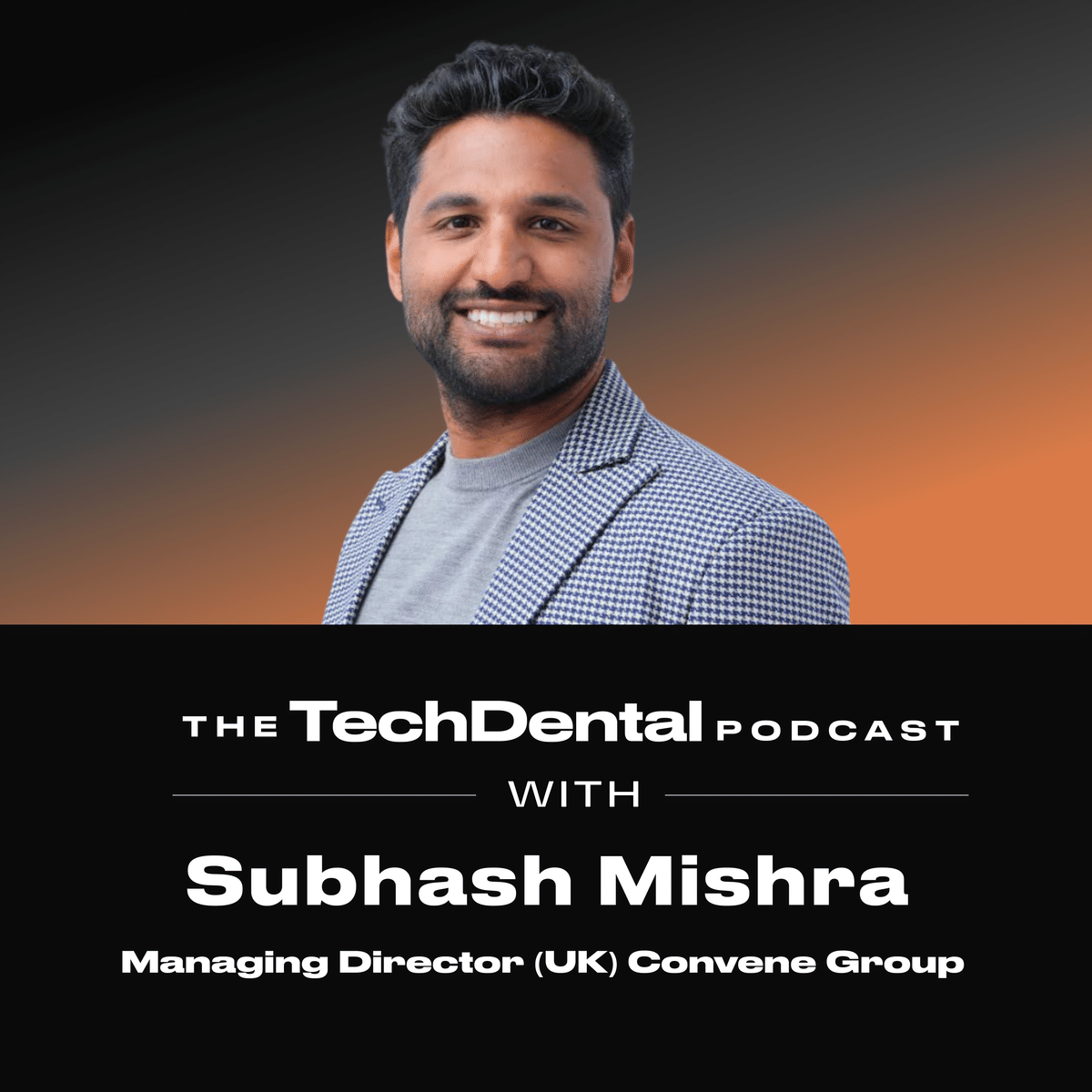
Direct answer: The dental front desk has been misclassified for decades. Most practices and groups treat it as an administrative cost centre, staffed to process check-ins, answer calls and take payments. That framing is both operationally incorrect and commercially expensive. Subhash Mishra, Managing Director for the UK at Convene Group, brings a perspective shaped by scaling consumer technology at Tinder, Doctify, BT Sport and WWE before moving into health tech. His thesis is precise: automated front desk infrastructure does not eliminate the value of human reception teams. It unlocks it. The practices that understand this distinction will build patient experiences and revenue engines that those still running on manual administration cannot match.
What Does Commercial Experience Outside Dentistry Reveal About the Dental Front Desk?
The questions that dental group leaders ask when evaluating operational technology are not unique to dentistry.
They are the same questions that every commercially sophisticated operator asks when evaluating any investment that touches customer experience, margin and team performance simultaneously.
Subhash Mishra has heard these questions in consumer tech, entertainment, transport and health tech before arriving in the dental sector. His conclusion is that the commercial logic is identical across all of them.
"The process for earning trust from a dental group, whether that's an entrepreneur-founded and controlled dental group or PE-backed one, and how you do that in consumer tech, it's so similar. Because ultimately, I succeed if my clients achieve their desired outcomes."
The specific tension that Mishra identifies as the defining challenge for dental group leaders is one that every operator in private healthcare recognises.
"The challenge that a lot of private dental groups have is how do I enhance margins and experience at the same time?"
The assumption embedded in that question is that margin improvement and patient experience improvement are in tension with each other. The insight that front desk automation delivers is that this tension is a product of manual administration, not an inherent feature of dental operations. When the administrative load is automated, both improve simultaneously.
The commercial framework Mishra applies to any dental group begins with a structured assessment of the investment case, signed off under NDA, that quantifies the impact of three categories: revenue growth from redeployed front desk capacity, cost reduction from eliminating manual administration, and patient experience improvements from removing waiting time and friction at check-in.
"We will typically save a dental practice roughly 100 hours per month. How do we translate some of those 100 hours into revenue growth? We're seeing six to seven percent revenue uplift in the UK, which greatly outstrips our costs."
That revenue uplift figure, combined with the cost reduction from automated processing versus manual check-in, produces an ROI that most CFOs and PE investors understand within a single conversation.
What Does the Hidden Cost of Manual Front Desk Administration Actually Look Like?
The hidden cost of manual administration at the dental front desk has three components: operational inefficiency measured in time and resource cost per transaction, missed revenue from unanswered calls and unaddressed patient inquiries, and an active patient base that represents a fraction of what it could be with consistent outbound engagement. Manual administration is not a neutral baseline. It is a compounding cost.
Mishra quantifies the baseline cost with a precision that most dental leaders have not applied to their own operations.
"With manual administration, it's costing roughly £1.20 for a dental practice in the UK to check in, take the payment, book the next appointment. Digital solutions do it for a fraction of that cost."
That £1.20 per transaction, multiplied across hundreds of daily appointments in a large group, represents a material operational cost that sits largely unexamined in most practice P&Ls.
The missed revenue dimension is more significant still.
Up to 30 per cent of inbound calls to dental practices go unanswered because reception teams are occupied with manual administrative tasks. Research from DenPlan indicates that 61 per cent of NHS patients are not accessing private treatments. Typically only 15 to 20 per cent of a practice's patient base holds a dental plan, despite the clinical and commercial logic of higher penetration.
"Your front desk is being held back by the time of manual administration. So ultimately it goes back to the transformation of taking a team that was historically a cost centre and historically an admin team and turning it into a profit centre and a patient engagement centre."
The patient base data compounds the picture further.
"On average, only 20 to 25 per cent of your patient base is active, meaning having booked an appointment in the last 12 months. So there is so much low-hanging fruit."
The dental practices and groups that have not yet made this calculation are, in effect, choosing to leave a measurable proportion of their addressable revenue on the table while simultaneously accepting a patient experience that is demonstrably inferior to what patients encounter in retail, hospitality and airports.
What Does a Self-Service Kiosk Actually Do in a Dental Practice and How Quickly Does It Deliver ROI?
A fully integrated self-service kiosk in a dental practice handles patient check-in, medical history form completion, NHS FP17 form submission, treatment payment, next appointment booking with deposit, and targeted promotion of dental plans, finance options and cosmetic treatment consultations. Time to value from implementation is typically two to three months, with deployment at a trial cohort of one to three practices taking approximately four weeks from contract signing.
The scope of what the kiosk handles is consistently wider than most dental leaders expect when they first encounter the technology.
Mishra is specific about why the integration depth matters.
"Because we integrate really deeply with various dental PMS systems, we can then also provide patients access to their medical history form or NHS FP17 form or GP17 in Scotland. Up to 60 per cent of patients arrive at a practice without having filled out those forms."
That figure alone represents a significant administrative burden that currently sits with reception staff: chasing incomplete forms, re-entering data, managing the flow of patients who have not completed their paperwork before arriving.
The promotional capability is where the revenue growth logic becomes most concrete for group operators.
"We can promote other services. That's what groups find very exciting about operational consistency. How do I ensure, if I've got some groups with in excess of a million appointments a year, that all of these patients get exposed to perhaps the right dental plan or a finance plan? We can provide videos or before-and-after photos to help drive a small makeover consultation."
The consistency dimension is critical for multi-site operators. A manual promotion approach depends on individual receptionists remembering to raise plans, finance and cosmetic options with every patient, across every practice, every day. A kiosk-based approach delivers that promotion consistently, at every touchpoint, without variation.
The practical outcome of this is visible at Serio Dental, an independent practice and Convene client that won Practice of the Year at the Private Dentistry Awards.
"What they're now able to do because it frees up so much time is a really nice concierge service. When you arrive at Serio Dental, they actually provide you hot towels and a coffee, so it's more like a five-star hotel. That was always their ambition, but they didn't always have the time."
That transformation, from a reception team managing administrative queues to a team delivering a hotel-level arrival experience, is the model that the front desk automation argument is pointing towards.
How Should CFOs and Investors Think About Front Desk Automation as a Strategic Investment?
The strategic argument for front desk automation that resonates with CFOs and PE investors is not efficiency savings. It is the transformation of the front desk from a cost centre to a profit centre. The investment case is built on three pillars: quantified revenue growth from redeployed capacity, measurable cost reduction from automated transactions, and operational consistency across sites that supports both staff retention and patient acquisition.
The CFO's role in dental group technology decisions has shifted materially over the past three to four years.
"A big trend in tech, especially in the last three to four years, is the CFO is an increasingly important decision maker and stakeholder. They're the custodian of capital allocation. They want to make sure that they're investing their company's capital in the most efficient way."
Mishra's approach to that conversation is structured around an NDA-enabled investment case built from the group's own operational data, not generic benchmarks.
"When we sign the NDA and then I use their data to model out what those outcomes look like, it's always an editable spreadsheet. So then they always go in and tweak it. They can see the return. They can see how quick it is for them to get that investment back."
The PE investment thesis has also evolved in ways that create specific alignment with operational technology like Convene.
"Historically PE funds were focused purely on financial engineering. Now driving operational efficiency is as big a part of their thesis as financial engineering. They're saying, if we're acquiring a number of practices every quarter, we need to make sure we're not just buying 50 disparate businesses. We're building one coherent, consistent business."
That coherence argument is one of the most powerful for multi-site and group operators. Manual administration, by its nature, is inconsistent. It varies by site, by shift, by individual. Automated processes deliver the same patient experience at every practice, every appointment, at the same cost.
The private equity lens adds a further dimension to this. PE investors who have portfolio companies outside healthcare are increasingly benchmarking dental group operations against the front desk automation standards they encounter in retail, hospitality and car rental.
"PE investors are often saying, we actually have other portfolio companies, not in healthcare, that seem to be more advanced in solving manual administration. We think there's a case for doing this in healthcare as well."
The dental group leaders who make this case proactively, before their PE investors raise it, demonstrate a commercial sophistication that supports valuation conversations.
We examined the operational signals that separate investor-ready dental businesses from those that attract discounted multiples in The Great Dental Reset: Why 2026 Will Reward the Prepared, Not the Big
What Is the Future of AI on the Dental Front Desk?
The next evolution of AI on the dental front desk is personalised, data-driven patient engagement at the point of arrival: surfacing relevant health messages, clinical trial opportunities and preventive care prompts based on the individual patient's medical history, demographic profile and treatment record. This capability is being piloted in hospital environments today and is moving towards dental group deployment as data infrastructure matures.
Mishra's vision of where AI on the front desk is heading is grounded in live implementation in hospital settings, where Convene works with approximately 95 per cent of Norwegian hospitals and a growing number of NHS trusts in the UK.
The use case that most clearly illustrates the potential involves a large NHS trust recruiting up to 25,000 patients annually for clinical trials while simultaneously delivering targeted public health messages across a high-volume patient population.
"As a patient checks in, they can get a relevant message saying you might qualify to be a candidate for a clinical trial based on your medical history. Please scan this QR code to learn more if you'd be interested."
The same logic applies to population-level preventive health messaging. A patient from a demographic with elevated risk for a specific condition receives a relevant message at the moment of check-in, delivered privately on a screen visible only to them, based on data already held in their medical record.
For dental groups, the equivalent capability means connecting PMS data to kiosk interactions in ways that surface the right treatment conversation, the right dental plan offer, the right cosmetic consultation prompt, for the right patient at the right moment. Not a generic promotion on a waiting room screen, but a personalised interaction driven by what is already known about that patient's clinical history and engagement pattern.
The prerequisite for this capability is the data infrastructure foundation that the most forward-thinking dental groups are currently building: clean data, standardised PMS, and integrated systems that allow patient information to flow between clinical and operational touchpoints.
"AI and any kind of automation is only going to really be powerful if the underlying data architecture is standardised to the point that it can be used."
We examined the data infrastructure requirements for AI-powered dental operations in From Front Desk to Control Plane
How Does Front Desk Automation Change the Role and Career of Reception Teams?
Front desk automation does not reduce the number of people working at the front desk of a dental practice. It changes what they do. The transition is from basic administration that does not challenge or develop the individuals performing it, to patient engagement, treatment coordination and concierge-level care that utilises the full range of their interpersonal capabilities.
This is the people argument for front desk automation, and it is as commercially important as the financial one.
Mishra is consistent on this point, and his evidence comes from the reception teams themselves rather than from management projections.
"What I love is that our biggest advocates for our service tend to come from the receptionists themselves and the practice managers. Because they're the ones who are really excited to have their roles transformed from basic admin. Receptionists do that job because they're people's people and it actually frees them up to progress in their own careers."
The career development dimension is particularly relevant in a labour market where front desk retention is a persistent operational challenge for dental groups. Roles that offer complexity, progression and the satisfaction of genuine patient impact attract and retain better people than roles defined primarily by repetitive processing tasks.
"Some receptionists end up taking more of a treatment coordinator role. It's just a much more exciting role for them. Receptionists say they actually now have time to think and actually now have time to properly provide a concierge service."
The connection between team experience and patient experience is equally direct.
"If you've got happier, more engaged employees, that ultimately feeds through to the patient experience. Patient care in healthcare, clearly the clinician is the most important piece, but there are softer aspects. It's also about how does the patient feel welcome and cared for and seen and heard."
The front desk team, freed from queue management and form chasing, becomes the primary architect of the arrival experience. In practices that have made this transition, the results are visible in patient feedback, treatment acceptance rates and retention.
"I predict you're always going to have human beings, very rightly so, on the front desk. But their role changes and it's better for the patient and it's better for the front desk employee as well. Because they are now free to take on more complex patient conversations."
We examined how AI adoption changes team roles and what leaders must do to manage that transition effectively in People-First AI: Why Most AI Projects Fail in Dentistry
What Are the Real Friction Points in Scaling Technology Across a Dental Group?
The primary friction points in scaling front desk technology across a dental group are PMS fragmentation from acquisition-led growth, the challenge of demonstrating time to value quickly enough to secure broader rollout mandates, and the cultural shift required to move from viewing patients as patients to viewing them as consumers with rising service expectations.
Mishra is direct about the scaling challenges Convene encounters, and his analysis applies broadly to any technology deployment across a multi-site dental organisation.
The PMS fragmentation problem is particularly acute in groups that have grown through acquisition.
"Some groups, especially those that have grown through a lot of acquisitions, are in the process of consolidating and going down to just one PMS over time. Historically that was a challenge, not just for Convene, but for lots of other providers."
A group running multiple PMS systems across its estate cannot achieve the operational consistency that makes automation genuinely valuable. The investment in PMS standardisation is therefore not just a technology decision. It is a prerequisite for extracting value from every subsequent operational technology deployment.
The patient-as-consumer shift is a more gradual cultural change, but it is accelerating.
"Patients themselves are used to seeing manual administration, particularly at the front desk, but they're used to seeing a much slicker, seamless process in retail, hospitality, at airports. They're coming to expect that, especially in dentistry where we've got so much choice."
The practices that recognise this shift and redesign their patient journey accordingly will benefit from it commercially. Those that do not will find themselves at a growing disadvantage as patient expectations continue to migrate upward towards the hospitality and retail benchmarks patients encounter every day outside their dental appointments.
Mishra's advice for dental leaders evaluating technology beyond their own sector is direct.
"Actually look to emulate best practices from other sectors. From a front desk perspective, some of the best practices are in hospitality. Don't just emulate best practices in dental but actually look beyond healthcare, borrow best practices from other sectors, give it a dental tweak and make it your own."
Key Takeaways
The dental front desk is a revenue engine misclassified as a cost centre. Manual administration is not a neutral baseline. It is a compounding cost that suppresses revenue, degrades patient experience and limits what reception teams can contribute.
A fully integrated self-service kiosk handles check-in, medical history forms, NHS form completion, payment, appointment booking, and targeted treatment and plan promotion. Time to value is typically two to three months from deployment.
Manual administration costs approximately £1.20 per transaction in a UK dental practice. Digital processing costs a fraction of that, while simultaneously freeing reception capacity for revenue-generating activity.
Up to 30% of inbound calls go unanswered when reception teams are occupied with manual tasks. Only 15% to 20% of patients typically hold a dental plan, despite the clinical and commercial case for higher penetration.
The CFO argument for front desk automation is not cost saving. It is the transformation of a cost centre into a profit centre, quantified through an investment case built from the group's own operational data.
PE investors are benchmarking dental group front desk operations against their non-healthcare portfolio companies and finding a significant gap. Those who close that gap proactively strengthen their valuation position.
Automation does not reduce reception headcount. It changes what reception teams do, shifting them from administrative processing to patient engagement, treatment coordination and concierge-level care.
PMS fragmentation from acquisition-led growth is the primary technical barrier to scaling front desk automation across a dental group. PMS consolidation is not just a tidying exercise. It is a commercial prerequisite.
The next evolution of AI on the dental front desk is personalised patient engagement at check-in, surfacing relevant health messages and treatment prompts based on individual patient data. This capability is live in hospital settings today.
About TechDental
TechDental is a strategic intelligence platform for founders, executives, operators and investors shaping the future of dentistry.
Through high-level analysis and systems-focused conversations, we explore how AI, governance frameworks and operating model design influence performance, scalability and enterprise value in dental organisations.
If you are building, scaling or investing in dentistry and want independent, systems-level insight into AI, governance and capital readiness:
For strategic advisory, board briefings or keynote speaking enquiries: www.techdental.com/advisory
The future belongs to those who deploy technology with discipline.
© 2026 RIG Enterprises Limited. All Rights Reserved. This article was authored by Dr. Randeep Singh Gill and is published under the TechDental brand, a trading name of RIG Enterprises Limited (Company No. 11223423), incorporated in England and Wales on 23 February 2018, registered at 1a City Gate, 185 Dyke Road, Hove, England, BN3 1TL. All editorial content, analysis, synthesis and intellectual property contained within this article are the original work of the author and remain the exclusive property of RIG Enterprises Limited. Opinions and statements attributed to named guests reflect the views of those individuals as expressed during recorded interviews and are reproduced here for editorial and informational purposes. No part of this article may be reproduced, distributed, transmitted, republished, or otherwise exploited in any form or by any means, whether electronic, mechanical, or otherwise, without the prior written consent of RIG Enterprises Limited. Unauthorised reproduction or use of this content may constitute an infringement of copyright under the Copyright, Designs and Patents Act 1988.