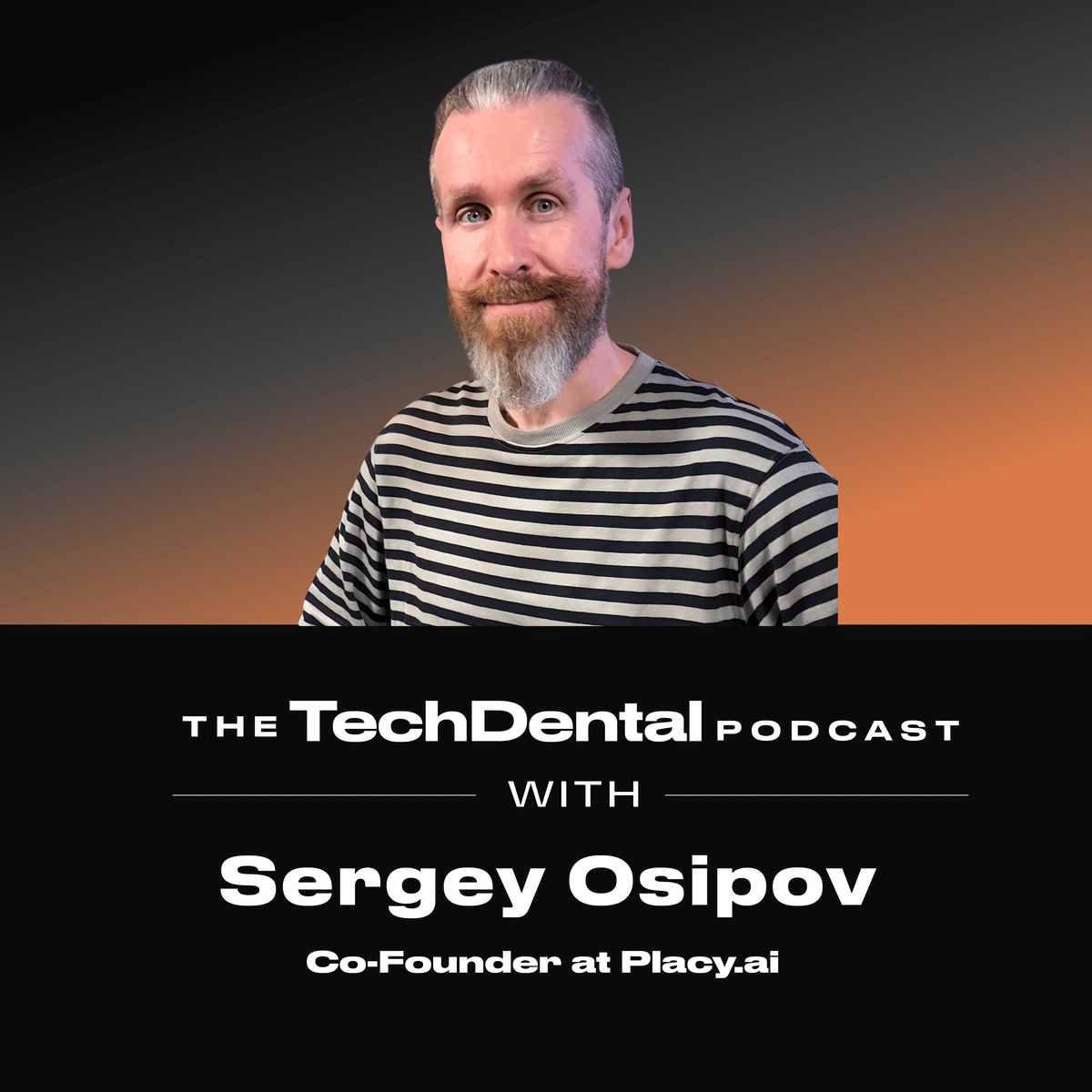
Direct answer: AI is not arriving at dentistry from the outside. It is already inside the operational layer, automating the first and last touchpoints of the patient journey while the clinical core remains untouched. What happens next is visible in real estate, a sector structurally similar to dentistry in its relationship-driven, distributed, trust-dependent nature, and one that is approximately two years ahead in its AI transformation curve. Sergey Osipov co-founded Cian, which reached a $1.1 billion IPO on the New York Stock Exchange, and now leads Placy AI, a platform deploying AI agents across real estate operations in Europe. His read of where AI disruption goes from here is not a prediction. It is a pattern he has already observed, measured and deployed at scale. The question for dental leaders is not whether the same disruption arrives in their sector. It is whether they are building for it or waiting for it.
Why the Portal Era Is Ending and What Comes After It
Every traditional industry that moved online in the early internet era built its digital infrastructure around one assumption: the visitor is human.
That assumption is no longer reliable. And it is changing the economics of every business that was built around it.
Sergey Osipov recognised this as the founding insight for Placy AI after more than a decade inside one of Europe's largest real estate portals.
"Half of the internet visits today on our websites, on the portals, are actually robots. They are crawlers, scrapers, indexing machines of big engines and all that stuff. Majority of them are still not human. They are not buyers. However, we are now seeing the fast growth of traffic from ChatGPT, Claude, Grok and other AI chatbots. And it's not just scrapers or indexing robots. It's real people who use AI assistants to visit your site."
The implication for platforms built around human behaviour is profound. The business model of real estate portals, like the SEO and listing promotion models that dominate dental patient acquisition, is premised on the idea that users are lazy. They do not click to page 35. So listings pay for prominence on page one.
AI agents do not behave this way.
"Robots are not lazy in case you appoint your AI assistant to find a flat to rent for you. So it will click everything, all 100 pages and will take the particular relevant listing to you, not the one which is paid on the first page. So this is just a very short explanation of why large marketplaces right now are in danger."
For dental practices, the equivalent question is this: when a prospective patient's AI assistant searches for a dentist in their area, books an emergency appointment, or compares treatment costs, what does your digital infrastructure return? Is it structured for human browsing or machine-readable intelligence?
The practices and groups that have not yet asked this question are operating on assumptions that are becoming obsolete faster than most leaders in the sector realise.
The 30 Per Cent Problem: How Much Revenue Is Being Lost Before AI Can Add Any
Before any conversation about AI adding value, there is a more immediate and quantifiable question: how much value is the current operational model losing?
Osipov's data from Placy's live deployment across real estate agencies is a direct analogue to the situation in dental practices.
"About 30 per cent of calls and requests are really lost. They are not answered, surprisingly, in real estate at least. They are just missed calls, they just don't follow up, they just forget to do something. Sometimes they don't understand the language."
The language dimension opens an additional dimension of lost revenue that most practice leaders have not modelled.
"Here in the Mediterranean countries, approximately 35 per cent of real estate transactions are done by foreigners. Chinese investors, Arabian countries, some others. Their English sometimes is almost unrecognisable. And human receptionists usually lose those leads. But AI understands everything because AI can understand really any pronunciation."
In a UK dental context, the international patient dimension is particularly relevant in urban and tourist areas. But the core statistic, a 30 per cent or greater loss rate on inbound leads due to missed calls, busy receptions and inadequate follow-up, is directly transferable.
The AI receptionist application that addresses this is not a future capability. Osipov is direct about when this technology matured.
"Call centres seem to me were automated three years ago with GPT-3. So you could add one more model to your financial assistant, kind of the receptionist in the dental office."
The commercial case for AI at the front desk begins not with what it adds but with what it stops losing. One third of a practice's inbound demand, if that is the true figure, represents a revenue opportunity that dwarfs the cost of any automation platform currently available to the sector.
We examined the front desk revenue opportunity in depth in The Front Desk Is a Revenue Engine, Not a Cost Centre
What Is the Difference Between Subscribing to AI and Building an AI-First Business?
The most important distinction in Osipov's analysis is one that most dental leaders and practice operators have not yet encountered, because most of them have not yet made the investment that would expose it.
The majority of businesses that have adopted AI tools in the past two years have done so by adding them to existing workflows. A new subscription. A new integration. An additional capability layered onto an unchanged operation.
Osipov describes this as the wrong approach, and explains why it will ultimately fail to deliver the transformation it promises.
"A lot of companies feel that they need to try AI, a lot of early adopters, B2B businesses. They subscribe to some assistance like Placy. And right now they still keep their staff, they keep their operations, their workflow, they change actually nothing. They just add one more virtual employee. Their business, yes, in the same incoming traffic they have 30 per cent more real deals because Placy doesn't lose calls. But from a budget point of view, it just increased because they need to pay 6,000 euro per year. This is not the correct approach of using AI."
The correct approach is what Osipov calls the full-stack AI company: a business designed from the beginning with AI as the operational default, and human roles defined around the tasks that genuinely require human judgement and relationship.
"The right approach is when you build something from the scratch, when you appoint robots first of all, on all the places, on all the functions that can be done by robots, and start from robots and allow robots to hire people, not vice versa."
The consequence of not making this transition is not merely leaving efficiency gains on the table. It is competitive vulnerability. The AI-first startups entering every traditional sector are not adding AI to existing operations. They are building without the cost base, the legacy processes and the cultural inertia that established players carry.
"When those businesses just subscribe to one more AI tool, it doesn't help them to solve their problem. Because it's still plenty of young startups, AI-first startups, that will kill those businesses, that old school businesses, inevitably. So it's not enough just to tick the box and to subscribe for one, two, three instruments with AI. It's necessary to fundamentally change their old school businesses. And this is the main issue."
For dental groups and practice operators, this is the most important strategic question of the current cycle. The investment in AI tool subscriptions is understandable and in many cases valuable. But if it is happening without a parallel conversation about how the business model itself needs to change, it is solving the wrong problem.
We examined the relationship between operational model design and AI effectiveness in You Cannot Buy Growth Before You Buy Control
What Proportion of Any Service Business Can Be Automated and What Cannot?
Osipov's framework for understanding which work AI will absorb and which it will not is one of the clearest currently available, and it applies directly to dental operations.
In real estate, his analysis identifies approximately 80 per cent of the broker's job as automatable.
"The only point that cannot be automated is to open the door when you show the property, and just to chat, to establish the social connection with the clients. That's like 10 to 15 per cent of the real job of the real estate agent. The major part is taken by sending SMSes, receiving calls, driving to the place, making records in CRM, chatting with the boss and all that stuff."
His framework for identifying which tasks fall into the automatable category is a phrase worth keeping.
"High friction, low judgement drops. So when you just copy and paste some links to the messenger, to the client, it's exactly high friction, low judgement stuff that can be inevitably automated."
In dental practice, the equivalent category is large and well-defined: appointment booking and rescheduling, recall messaging, insurance verification, form completion, payment processing, referral generation, routine correspondence, financial reporting and data entry. These are tasks that consume significant human time, require minimal clinical judgement and are performed with high error rates when done manually by a team operating under pressure.
The tasks that cannot be automated are equally identifiable: clinical diagnosis, treatment planning, chair-side patient communication, anxiety management, complex interdisciplinary decision-making and the relationship-building that drives treatment acceptance and retention.
The dental practices that understand this distinction and design their operations around it will not reduce headcount through AI adoption. They will redirect human capability from the first category to the second. That redirection has direct commercial implications: more time for treatment coordination, more effective plan promotion, better patient experience and higher treatment acceptance rates.
"The right approach is to have an AI-enhanced workforce. Enabling people, freeing up the front desk to make patients genuinely feel cared for from the moment they walk into the practice and being freed up from being an admin team to being a revenue growth team, being able to perform at the top of their abilities."
Why Trust Is the Only Real Barrier Left to AI Mass Adoption
The technology for AI-powered dental operations already works. The hallucination problem that made early AI tools unreliable has been substantially solved in domain-specific vertical applications.
Osipov is precise about this.
"Technically, AI can work without hallucinations right now when you use some paid tools. Hallucination is right now the burden of the free products. In very specific areas, in industry vertical startups like Placy, we've already solved this problem a year ago with the knowledge base, with specific problems, with some technical solutions. So technically, we can trust AI in so many cases already."
The barrier to mass adoption is not technical. It is cultural and temporal.
"People in general don't trust AI. They already learned all the hallucinations, all the nuances, and they don't trust AI in general. It takes time. They need a couple of years more to live with this. The same with AI adoption as with online payments. You remember in the 2000s, everyone had credit cards but nobody really paid online. It was technically possible 25, 20 years ago. But some five, ten years later, everyone pays online. It's no question at all."
For dental leaders, this trust dynamic operates at two levels simultaneously.
The first is patient trust: will patients accept AI-mediated touchpoints in their care journey? The evidence from sectors ahead of dentistry on the adoption curve suggests that patients adapt quickly when the experience is genuinely superior, and that the human touchpoints that matter most, the clinical encounter, the treatment explanation, the anxiety management - are unaffected.
The second is staff trust: will clinical and administrative teams adopt AI tools or resist them? Osipov's experience across real estate agencies is instructive here. The early adopters who deploy AI as an additional capability while maintaining existing staffing structures find that their team members become the platform's most enthusiastic advocates, precisely because AI frees them from the parts of their role that frustrate and fatigue them most.
"People are very slow with this mass adoption. In our technical minds, everything already happened. We watched each next OpenAI dev day presentation and we think, this is the future, it's already here. And the clients in the field are still like they're used to mobile phones like Nokia with buttons."
The gap between what the technology can deliver and what the market is ready to accept is not a reason to delay investment. It is a reason to invest now, while the first-mover advantage is still available.
What Winning in the AI Era Actually Requires: Lessons From a Founder Who Has Built at Scale
Osipov's reflections on what the AI transition means for founders and business operators are grounded in the experience of having scaled a business to unicorn status and started again.
His comparison of what it took to launch a technology business twenty years ago versus today is instructive for any dental leader evaluating the cost and pace of operational transformation.
"Say I could compare the situation with 20 years ago when I remember launching something new, we registered the domain name and it was necessary to set up our own server to deploy the website, to organise that SMTP server for corporate emails and all that stuff, it took several days. Nowadays you just go to Google Workspace, register there, it takes just one hour, maybe even half an hour just to open the whole workspace. Amazon Web Services, Azure platform, it's a fantastic platform. We couldn't even dream about this 20 years ago."
The decreasing cost and complexity of technology infrastructure is not just a startup story. It is directly relevant to dental practices and groups evaluating AI adoption. The tools that required enterprise-level IT departments and significant capital investment five years ago are now accessible to independent practices on subscription pricing.
His framework for what AI will ultimately do to traditional business timelines is equally significant.
"In my experience, average time that I spent on my previous startups, it's like seven, eight, nine, 10 years until you think, this is a business, you could leave the position of CEO. It's not a journey for a couple of years. It's seven to 10 years."
This is a corrective to the startup mythology that AI tools create shortcuts to scale. Building something meaningful in a regulated, relationship-dependent sector like dentistry requires the same ingredients it always has: validated problem definition, genuine product-market fit, trust built over time and capital deployed with discipline.
What AI does is compress certain stages of that journey. Research, content creation, lead generation, administrative automation, financial reporting, compliance monitoring. These functions, which previously required teams, can now be handled by fractional human talent augmented by AI. That changes the economics of building without changing the fundamentals of what building actually requires.
"The winners in the AI age will be those who act before disruption hits, not those who wait to adapt."
Key Takeaways
The assumption that digital infrastructure serves human visitors is breaking down. More than half of internet traffic is now non-human. AI agents acting on behalf of users will navigate, evaluate and transact in ways that make human-centric design inadequate.
Approximately 30% of inbound leads in service businesses go unanswered or unresolved. In dental practices, the figure may be higher. AI-powered reception tools address this loss directly and with measurable commercial impact from day one.
Adding AI tools to unchanged workflows does not produce transformational outcomes. It produces incremental gains and additional cost. Transformational outcomes require redesigning the operational model around AI capabilities, not adding AI to an existing model.
Approximately 80% of the administrative and communication work in service businesses qualifies as high friction, low judgement, and is therefore automatable. The 15% to 20% that is not automatable is relationship-building and contextual human judgement.
AI mass adoption is not blocked by technology. The hallucination problem has been solved in domain-specific vertical applications. The remaining barrier is trust, and it will erode on the same timeline as every previous technology transition.
AI-first startups are entering every traditional sector without the cost base, legacy processes or cultural inertia of established players. Subscribing to AI tools without rethinking the operating model does not create defence against this competition.
Building enterprise-grade AI-powered products in regulated sectors requires genuine investment, robust compliance architecture and longer timelines than AI hype suggests. The fractional operating model, combining a lean core team with AI capability and specialist talent on demand, is the capital-efficient path to scale.
The dental sector's transition timeline mirrors real estate, offset by approximately two years. The architectural and strategic decisions that determine competitive position in that transition are being made now.
About TechDental
TechDental is a strategic intelligence platform for founders, executives, operators and investors shaping the future of dentistry.
Through high-level analysis and systems-focused conversations, we explore how AI, governance frameworks and operating model design influence performance, scalability and enterprise value in dental organisations.
If you are building, scaling or investing in dentistry and want independent, systems-level insight into AI, governance and capital readiness:
For strategic advisory, board briefings or keynote speaking enquiries: www.techdental.com/advisory
The future belongs to those who deploy technology with discipline.
© 2026 RIG Enterprises Limited. All Rights Reserved. This article was authored by Dr. Randeep Singh Gill and is published under the TechDental brand, a trading name of RIG Enterprises Limited (Company No. 11223423), incorporated in England and Wales on 23 February 2018, registered at 1a City Gate, 185 Dyke Road, Hove, England, BN3 1TL. All editorial content, analysis, synthesis and intellectual property contained within this article are the original work of the author and remain the exclusive property of RIG Enterprises Limited. Opinions and statements attributed to named guests reflect the views of those individuals as expressed during recorded interviews and are reproduced here for editorial and informational purposes. No part of this article may be reproduced, distributed, transmitted, republished, or otherwise exploited in any form or by any means, whether electronic, mechanical, or otherwise, without the prior written consent of RIG Enterprises Limited. Unauthorised reproduction or use of this content may constitute an infringement of copyright under the Copyright, Designs and Patents Act 1988.