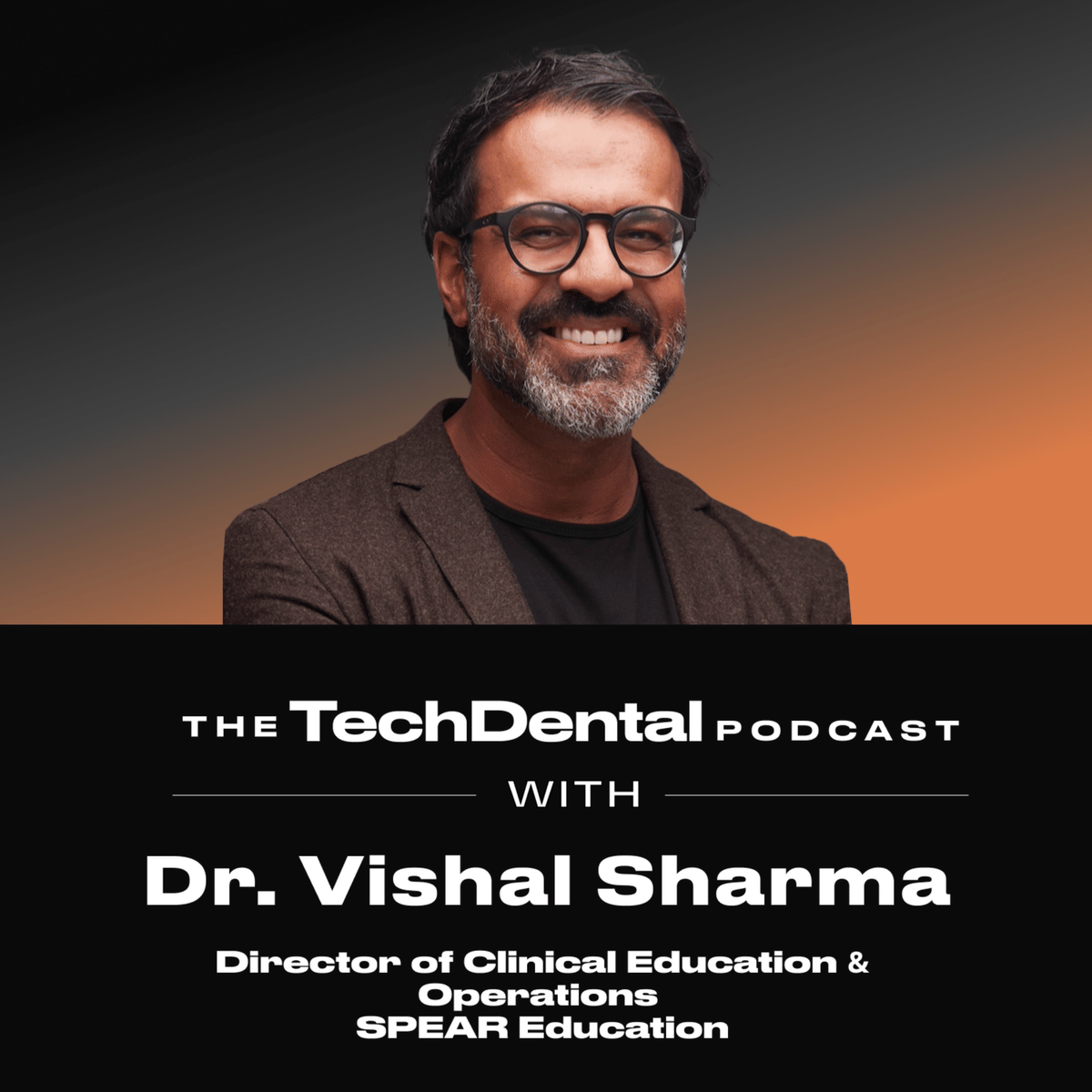
Direct answer: Dentistry is producing graduates with fewer hands-on clinical skills than any previous generation, entering a profession that has never been more technically complex. The combination of pandemic-disrupted training, siloed curricula, ballooning debt loads and a digitally literate patient base expecting sophisticated care has created a structural skills gap that traditional continuing education cannot close. Dr Vishal Sharma, Director of Clinical Education and Operations at Spear Education, has spent more than two decades at the intersection of clinical practice, large-scale DSO operations and educational leadership. His assessment is direct: the profession needs to move from hours-based, siloed continuing education to structured competency-based pathways, supported by objective AI-driven skill assessment and immersive hybrid learning environments. The technology to do this is not coming. It is here.
When Did It Become Clear That the Old Way of Training Dentists Was No Longer Working?
The structural skills gap in dentistry did not emerge suddenly.
It was building for years before the pandemic made it impossible to ignore.
Dr Vishal Sharma has observed this from three distinct vantage points: as a clinician, as a director of clinical operations overseeing hundreds of practices across a Canadian DSO, and now as the leader of one of the most respected postgraduate dental education ecosystems in the world. His assessment of when the problem became structural is precise.
"Post pandemic, the lack of clinical training was really exacerbated by the pandemic. We know that universities worldwide, dentists are now graduating with less clinical skill sets than they did a generation ago."
The pandemic accelerated a decline that was already in motion. But it also created an opening. The forced transition to virtual and remote learning during lockdown demonstrated, for the first time at scale, that meaningful clinical education could happen outside the lecture theatre and the simulation lab. That learning created the foundation on which the hybrid models now being deployed by organisations like Spear Education were built.
The complexity of what graduates are entering has also changed beyond recognition.
"We have patients coming in in their 20s or 30s or 40s who are potentially expecting to live to be 100 plus years of age, and they're wanting healthy dentistry. The unspoken word in dental school a generation ago was that at the age of 55 or 60, your patients would end up in a denture. That is not the case now."
The profession is treating patients across longer lifespans, with more complex interdisciplinary needs, using more sophisticated technology, while facing a digitally literate patient base that arrives with information, opinions and rising expectations. The training pipeline has not kept pace with any of those shifts.
"How do you give them all that information in a shorter period of time? That's one of the big challenges we're seeing in early career dentistry and recent graduates right now."
What Are the Biggest Skills Gaps Showing Up in Early Career Dentists Today?
The most significant skills gaps in early career dentists today are not primarily technical. They are diagnostic, interpersonal and integrative. The ability to diagnose comprehensively, communicate treatment options to a sophisticated patient base and connect clinical skills across disciplines in a multidisciplinary treatment context are the areas where the gap between dental school preparation and clinical practice reality is widest.
Sharma's diagnosis of where the gap shows up is grounded in direct observation across clinical networks of considerable scale.
Dental school provides a structured, sheltered environment. It teaches skills. But it teaches them in isolation.
"A lot of the disciplines are segmented. Here's endo, this is restorative, here's prosthodontics, et cetera. Whereas in clinical practice, that's not the case. You have a patient who comes in and they don't know which discipline they need. It's a multidisciplinary approach that we have to take."
The transition from that structured environment into clinical practice is jarring for most graduates. The competencies they have acquired were developed in conditions that do not resemble the environment they are now working in.
"You go from a sheltered, structured environment where you have these segmented skill sets and you now go into an environment which is not sheltered, certainly not streamlined. You have to take all of these disjointed skills that you learned, package them together to be able to execute them and provide a patient with exceptional care."
The barriers to bridging that gap through continuing education are real and well-documented. Time is the primary constraint for practising clinicians, particularly in a landscape where the financial pressure of graduate debt loads forces many to work evenings and weekends.
"It's not uncommon for someone to come out of an American dental school $500,000 in debt. When I started my career, you could build a practice for $500,000. Time constraints, obviously limitations on cost. Travel is certainly much less glamorous than it was in the past."
The three barriers of time, cost and travel have collectively suppressed the depth and regularity of continuing education that early career dentists need precisely when they need it most.
What Is the Difference Between Integrated and Segmented Dental Education?
Integrated dental education delivers clinical competency through structured, sequential pathways that move a practitioner from foundation to advanced skill across multiple disciplines simultaneously. Segmented education responds to self-identified pain points through isolated courses. The critical failure of segmented education is that it requires dentists to know what they do not know, which is precisely the gap that education is meant to close.
This distinction is at the core of Spear Education's model and one of the most important concepts in the current conversation about postgraduate dental training.
Sharma explains the problem with traditional continuing education with clarity that comes from years of observing where it breaks down in practice.
"With segmented CE, you have to understand what your limitations are. What I found in my career, evaluating the careers of peers and people that I've observed, is you can assess in posterity and say, that's where I lacked a skill set. But while you're going through that process, it's difficult to know. It's what you don't know."
A dentist who does not know that they are weak in a particular area of occlusion, or who has not yet encountered the diagnostic complexity that would reveal a gap in their prosthodontic foundation, will not self-select a course addressing that gap. By the time the gap becomes visible, it has often already resulted in clinical errors, suboptimal patient outcomes or referrals that could have been avoided.
The structured pathway model addresses this by removing the requirement for self-diagnosis.
"If you can have a more structured, linear pathway or programme that takes you from A to Z in various skill sets, various disciplines, you're covering everything. And then you're not relying on a dentist to self-assess themselves, to identify what they don't know."
The practical implication for DSOs and group operators is significant. An organisation that allows its clinical education to remain in the segmented model is, in effect, leaving the quality of its clinical workforce development to individual self-awareness and self-motivation. Both are unreliable predictors of systematic competency development at scale.
How Does the Hybrid Learning Model Solve the Time, Cost and Travel Problem Without Sacrificing Rigor?
The hybrid learning model, as implemented at Spear Education, combines on-demand digital content, live remote faculty interaction, hands-on exercises conducted in the clinician's own practice environment, objective AI-powered assessment via intraoral scanning data, and in-person workshop experiences. The model is not a compromise. It is a structural improvement on the traditional CE model in every dimension except peer energy and faculty presence, which it supplements rather than replaces.
The breakthrough in the hybrid model is the introduction of objective, numerical skill assessment at the point of practice, not the point of review.
Sharma describes a proof of concept currently being piloted with a DSO partner that illustrates the shift precisely.
Physical preparation models are sent to participants at their own practices. Clinicians complete preparation exercises on the models, then scan the result with an intraoral scanner. The scan data is then assessed against objective criteria: preparation depth to the appropriate microns for the material selected, marginal smoothness, margin integrity.
"We now have scanned data that will tell you whether you're objectively and numerically reducing your preparation to the appropriate microns based on the material that you've selected. Dentsply, Sirona, iTero, they now have scanners that are going to tell you how rough or potentially how smooth your preparations are."
The assessment is simultaneously objective and remote. No travel. No faculty scheduling. No time off the chair beyond the exercise itself.
Simultaneously, the physical model can be posted to a senior prosthodontic faculty member for subjective review under a microscope. The two forms of feedback are complementary rather than competitive.
"I think having a combination between the two is the ideal sweet spot. The objectivity is certainly something that's been long overdue and is a welcome addition to that assessment protocol."
The in-person element is not removed from the model. It is repositioned as the culmination of a process rather than the entirety of it.
"All of it eventually leads to still an in-person workshop. I still think you cannot substitute the energy, the collaboration with your peers, and the interaction with the renowned faculty member. But these do a great job of augmenting that."
How Are DSOs Using Structured Clinical Pathways to Standardise Competency Across Networks?
DSOs that deploy structured, role-based clinical education pathways can establish a defined and measurable standard of clinical competency across their entire network, independent of the skill level of any individual clinical director or regional leader. The model replaces the unsustainable approach of trying to scale individual excellence with the scalable approach of systematising the pathway to excellence.
Sharma identifies the central failure mode in DSO clinical education with precision born from direct experience inside that environment.
"The chief clinical officer typically is exceptional. The challenge is you can't scale the programmes that made them successful because you can't duplicate or replicate or clone them."
What most DSOs have done historically as a result is a collection of one-off courses on isolated topics. A socket preservation course. A direct restorative course. A course on veneers. Each individually useful. Collectively, they recreate in the continuing education environment the same segmented, disconnected structure that graduates are already struggling to overcome from dental school.
"There's no cohesive linking of all of it. That disjointed nature still speaks to some of the shortcomings of dental school where it's not multidisciplinary, it's not cohesive, it's so segmented."
The structured pathway model that Spear is developing in partnership with DSO clients begins from a different starting point. Rather than asking what courses exist, it asks what the organisation actually needs its clinicians to be able to do, what standard they are aspiring to, and what educational sequence will reliably produce that result.
"For some organisations, it's scan every patient. For other organisations, it's same-day clinical dentistry. From a hygiene perspective, maybe it's GBT or utilising oral DNA. We take what's important to them from their clinical values. We then cater the education and the pathway to ultimately achieve what they're hoping to accomplish."
When a DSO can define and deliver that pathway consistently across all of its sites, it has done something that is both educationally significant and commercially valuable. It has converted clinical competency from an individual variable into an organisational asset.
We examined how standardised operational systems create scalable value across dental groups in You Cannot Buy Growth Before You Buy Control
Why Is Objective AI-Driven Skill Assessment the Missing Piece in Dental Education?
Dentistry as a profession is built on objective numerical data: material strengths measured to the megapascal, preparation depths measured to the micron. Yet clinical skill assessment has remained stubbornly subjective, dependent on the judgement of individual faculty members applying inconsistent criteria. AI-powered scanning tools are closing that gap by bringing the same objective numerical rigour to skill evaluation that the profession has long applied to material science.
This is the structural shift that Sharma argues is most overdue in dental education and most consequential for patient outcomes.
"Our profession has become so focused on objective data. We know the thickness of materials to microns. We know the strength of various dental procedures and materials and restorative modalities to the megapascal. So it is such an objective, numerical-based profession. And so it follows suit that the assessment of our clinical skill sets would want to have that objective numerical data."
The availability of that data through intraoral scanning technology creates a new category of educational feedback. Not the opinion of a single faculty member reviewing a preparation, but an objective comparison of that preparation against a defined numerical standard, available immediately, at the point of practice.
The real-time dimension of that feedback is where the educational value is most significant.
"If you can go through a preparation exercise or an endo exercise and the AI can tell you immediately where you're making a mistake with instrumentation and putting the file at risk for separation, that is such a fantastic way to learn. Much more effective than waiting to see whether it's successful or whether it's a failure later on."
The confidence gap that plagues many early career dentists, the gap between knowing the theory and trusting the hands, is a product of insufficient repetition with adequate feedback. AI-powered real-time assessment directly addresses that gap by compressing the feedback loop from days or weeks to seconds.
"Learning in the moment is certainly a more effective opportunity to improve your skill set."
The downstream benefit extends beyond the individual practitioner. Faster, more reliable skill acquisition means fewer errors in live clinical environments. In a market where digitally literate patients are increasingly informed and less tolerant of professionals learning on the job, that matters commercially as well as clinically.
"Not only does it benefit the practitioner, but it also has an immense benefit for the patient, the public as well."
What Does the Future of Dental Education Look Like in Five Years?
Within five years, the leading edge of postgraduate dental education will be immersive, multisensory and AI-supported. Virtual reality environments will simulate the full clinical experience, including patient communication, diagnostic reasoning and mechanical skill execution, in a format that can be delivered anywhere, repeated indefinitely and assessed objectively.
Sharma's vision of where dental education is heading is grounded in technology that is already in development rather than theoretical possibility.
"You're going to have some virtual reality goggles on. It'll be immersive. You'll have the audio inputs from a clinic and you might be sitting at a tabletop, but it's going to appear as if you're in a clinic. And you might be working on a printed root canal 3D model, but that'll be part of a patient. And so that patient will be interacting. They'll be talking about the pain that they're experiencing, what their symptoms are."
The significance of that immersive environment is not just the replication of clinical technique. It is the simultaneous training of the full range of skills that clinical practice requires: communication, diagnostic reasoning, patient management, procedural execution.
"Not only are you going to have to learn the skill set in terms of the mechanical instrumentation, but everything from the diagnostic aspect to dealing with a difficult patient who's going to be in pain, things that maybe are not effectively supported in dental school, and certainly skill sets that are difficult to learn via webinar."
For DSOs and group operators planning their clinical education investment over the next three to five years, this trajectory has direct strategic implications. The organisations that build their educational infrastructure around the hybrid and AI-supported model now will be positioned to integrate immersive learning capabilities as they mature. Those that continue investing in traditional one-off CE events will find themselves increasingly far from the leading edge of both educational effectiveness and clinical competency.
Is AI in Dental Education and Clinical Practice a Future Application or a Present Reality?
AI in dentistry is not a future application. It is a present operational reality. Radiographic detection, pathology scoring, AI-powered crown design and diagnostic support tools are deployed in clinical environments today and improving at a rate that makes year-on-year comparison significant. The most costly professional mistake a dentist can make is to treat AI as something to engage with later.
Sharma is unambiguous on this point, and it is the most important practical message for any dental professional or practice leader who is still observing from a distance.
"I think the main myth is that it is a future application. It is here. And we know right now that there's AI radiology. What these programmes looked like a year ago, they've evolved significantly. Some of it, of course, is future application. But the myth is that it is a future application. It's here now. Best for dental professionals to embrace it. You certainly don't want to get left behind on this aspect and make your career obsolete."
The pace of development makes the timing of engagement consequential. A dental professional who waits two years to engage with AI-assisted diagnostics will be starting from the same point as someone who engages today, but in a market where their competitors have two years of familiarity, workflow integration and patient communication around those tools already established.
The same logic applies to practice leaders and DSO executives evaluating when to invest in AI-powered educational infrastructure. The question is not whether to engage. It is how to engage in a sequence that builds capability without creating dependency on tools before the operational foundations are ready to support them.
We examined the sequence in which AI tools should be introduced to dental organisations in AI Didn't Fix Dentistry. Intelligence Will.
Key Takeaways
Dental graduates are entering practice with fewer hands-on clinical skills than any previous generation, into a profession that has never been more technically complex. This gap is structural, not cyclical.
The foundational failure of traditional continuing education is that it requires dentists to know what they do not know. Structured pathway programmes remove that dependency by designing comprehensive, sequential development regardless of self-identified gaps.
The three primary barriers to continuing education, time, cost and travel, are all addressed by the hybrid learning model, which delivers foundational content digitally, hands-on exercises at the clinician's own practice and faculty feedback remotely and in-person.
Objective AI-powered skill assessment via intraoral scanning brings the same numerical rigour to clinical skill evaluation that dentistry already applies to material science. Real-time feedback at the point of practice compresses the learning loop from weeks to seconds.
DSOs that replace one-off CE events with structured, role-based competency pathways convert clinical quality from an individual variable into an organisational asset that scales across the entire network.
Faster skill acquisition through AI-supported education reduces the volume of errors made in live clinical environments, benefiting patients, practitioners and the organisations accountable for both.
Within five years, immersive VR environments simulating the full clinical experience including patient interaction, diagnostic reasoning and procedural execution will define the leading edge of postgraduate dental education.
AI in dentistry is not a future application. It is a present operational reality. The professionals and organisations that engage now will have a compounding advantage over those that wait.
About TechDental
TechDental is a strategic intelligence platform for founders, executives, operators and investors shaping the future of dentistry.
Through high-level analysis and systems-focused conversations, we explore how AI, governance frameworks and operating model design influence performance, scalability and enterprise value in dental organisations.
If you are building, scaling or investing in dentistry and want independent, systems-level insight into AI, governance and capital readiness:
For strategic advisory, board briefings or keynote speaking enquiries: www.techdental.com/advisory
The future belongs to those who deploy technology with discipline.
© 2026 RIG Enterprises Limited. All Rights Reserved. This article was authored by Dr. Randeep Singh Gill and is published under the TechDental brand, a trading name of RIG Enterprises Limited (Company No. 11223423), incorporated in England and Wales on 23 February 2018, registered at 1a City Gate, 185 Dyke Road, Hove, England, BN3 1TL. All editorial content, analysis, synthesis and intellectual property contained within this article are the original work of the author and remain the exclusive property of RIG Enterprises Limited. Opinions and statements attributed to named guests reflect the views of those individuals as expressed during recorded interviews and are reproduced here for editorial and informational purposes. No part of this article may be reproduced, distributed, transmitted, republished, or otherwise exploited in any form or by any means, whether electronic, mechanical, or otherwise, without the prior written consent of RIG Enterprises Limited. Unauthorised reproduction or use of this content may constitute an infringement of copyright under the Copyright, Designs and Patents Act 1988.